Deep Look at ITSM
IT teams provide end-to-end services to their customers by planning, creating, designing, delivering, managing and maintaining IT-related services. The activities for the implementation and management of these services are collected under the following main service headings:
- Event Management
- Knowledge Management
- Service Request
- Asset Lifecycle Manager
- Self Service
- Policy and Compliance
- Service Management
- Reporting & Dashboards
- Process Manager
- Change & Release
- Incident & Problem
- Service Catalog
- Configuration Management
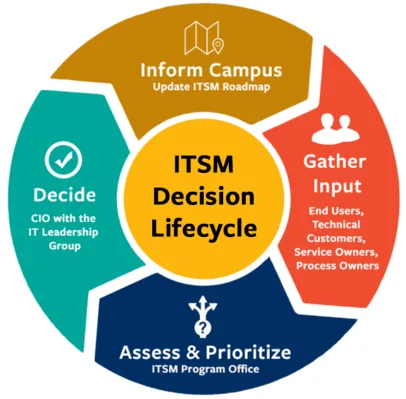
We can divide “ITSM Decision Lifecycle” into processes as ‘Gather Input’, ‘Assses & Prioritize’, ‘Decide’ and ‘Inform Campus’. According to these stages, the companies that provide IT services plan the services to be offered to its customers and collect information and focus on priorities. Then, they decide and apply. Moreover, along with customer needs, compliance also plays a big role. In line with this harmony, the roadmap is presented to the technical team and customers in a transparent method.
There are many aspects that corporate customers who purchase services can benefit from thanks to the ITSM cycle. Let’s talk about these:
- The process is taken under control by gathering all the needs under a single standard.
- Employees know the services provided and are trained on how to use them.
- Any problem that may be encountered is detected faster, and action is taken immediately thanks to result-oriented solutions. Thus, the extra costs that may arise later on are prevented.
- Supports job production as performance and efficiency will be constantly monitored.
- Quicker response to changes in the relevant market.
We can list the benefits to the IT department of corporate company that purchased the service as follows:
- Ensuring order with defined roles and responsibilities,
- Monitoring of all services received and finding a faster solution to any problem,
- Preventing potential problems before they occur, finding permanent solutions to recurring problems,
- Analyzing by providing IT data, increasing efficiency with the collected data,
- By prioritizing the satisfaction of technical and normal end users, a positive effect on the corporate culture is achieved.
What's ITIL?
ITIL: Information Technologies Infrastructure Library
The most popular approach methodology of these services is ITIL. It is a framework designed to standardize the services mentioned above, focusing on business value. This standard aims to ensure compliance, to observe and measure development, to increase performance and to maintain productivity.
ITIL’s service strategy is supported under 3 main headings:
- Service Design
- Service Transition
- Service Operation
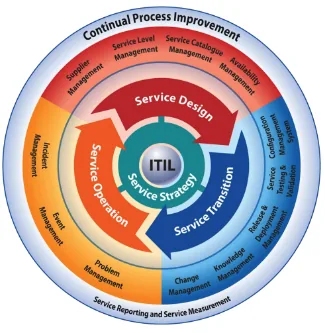
In the Service Strategy, business goals, business work flows and requirements are determined; In Service Design, service applications suitable for the IT policy, processes and company structure of the relevant institution are determined; In Service Transition, changes due to internal and external factors are managed and reported; In Service Operation, there are different solutions in the follow-up, implementation and management of services by dividing them into time processes. All services offered by ITIL are found to find the best and most efficient ways over time, aiming to increase performance.
Generally, companies that offer IT services provide the establishment and maintenance of IT technology under the umbrella of ITSM according to the customer’s company structure. They ensure that this process is set up and managed correctly. In addition, they provide both the technical and non-technical employees in the client company to learn the process and also IT work is done accordingly.
One of the most important ITSM processes is the Incident Management step. In this step, in case of unplanned or planned service interruptions, the technical team focuses on the uninterrupted communication of the product with the product users in the process of responding and re-operating.
Incident Management
At this point; if we focus on incident, we can define it as an unplanned and urgent incident that may affect a part of the service quality of a product or the entire product.
Being able to focus on customer satisfaction is one of the indispensable features of all companies in this age. In this context, any service interruption that can have a small or big impact can cost companies dearly. According to Gartner, most organizations’ outages cost more than $300,000 per hour. For some web-based services, this number may be much higher.
ITIL methodology for incident management, which can pose such an important problem, always offers a solution approach to find the best process for meeting the problem, understanding & analyzing, management, communicating with customers and learning lessons. This solution culture aims to increase the efficiency of the relevant employees in every step of the process by creating some plans, methods and templates in each company over time, taking the process more dynamic and fast and minimizing the disruption in the work flows.
Among these purposes, managing the communication with customers in crisis situations is one of the most important processes of ITIL. At this point, PMI attaches great importance to establishing correct and transparent communication with customers, stakeholders and service owners. By avoiding a communication with ambiguous, implicit and temporary answers, correct and effective communication with the audience always speeds up this process. Even when you are in a crisis time, you can turn it into an opportunity by creating a very positive effect.

Incident management can be fully realized with the synchronized and systematic operation of the necessary applications, tools and employees in the system with each other. We can list the processes under main headings as follows: Incident tracking, employee written and visual communications, warning process, documentation and status page processes. More than one tool serves in the market for these processes.
Incident tracking is necessary to determine and analyze the root cause of incident. It provides database support for tracking and recording the incident details. Thanks to written and visual communication, it is focused to understand the problem and incident details more easily. Not only can the problem be solved, but also information is collected and analyzed through documentation processes. Thus, it is aimed to prevent from re-occurrence. The synchronization of the warning process with the third-party applications used, it helps employees to take quick action during the incident solving phase. Public status page is the page where we can monitor information about incident such as current status, severity, priority and impacted services. It is required for a more transparent and comfortable incident management involving both internal employees and customers.
As we mentioned above, keeping everyone in the process by establishing effective, fast and transparent communication with both internal stakeholders and customers plays an important role in the good management of this process.
Incident Communication & Hosted Status Page
As StatusEntry, we offer Affordable & Stylish Hosted Status Page for incident communication to your business.
- You can notify your subscribers for each incident update not to oblige them to check your page periodically to keep track of the latest status.
- Your customers can subscribe to your page to receive updates for your incidents by selecting the notification channel that they prefer.
- They can get notified via public status page, email, webhook and slack for the incident updates that you select to notify your subscribers.
For more detailed information, you can check out the Features section.